
Beschreibung
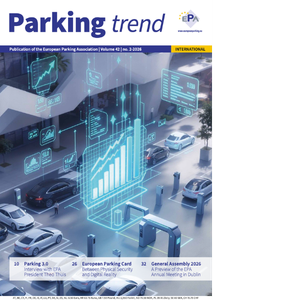
Parking trend 2/2026 – ePaper
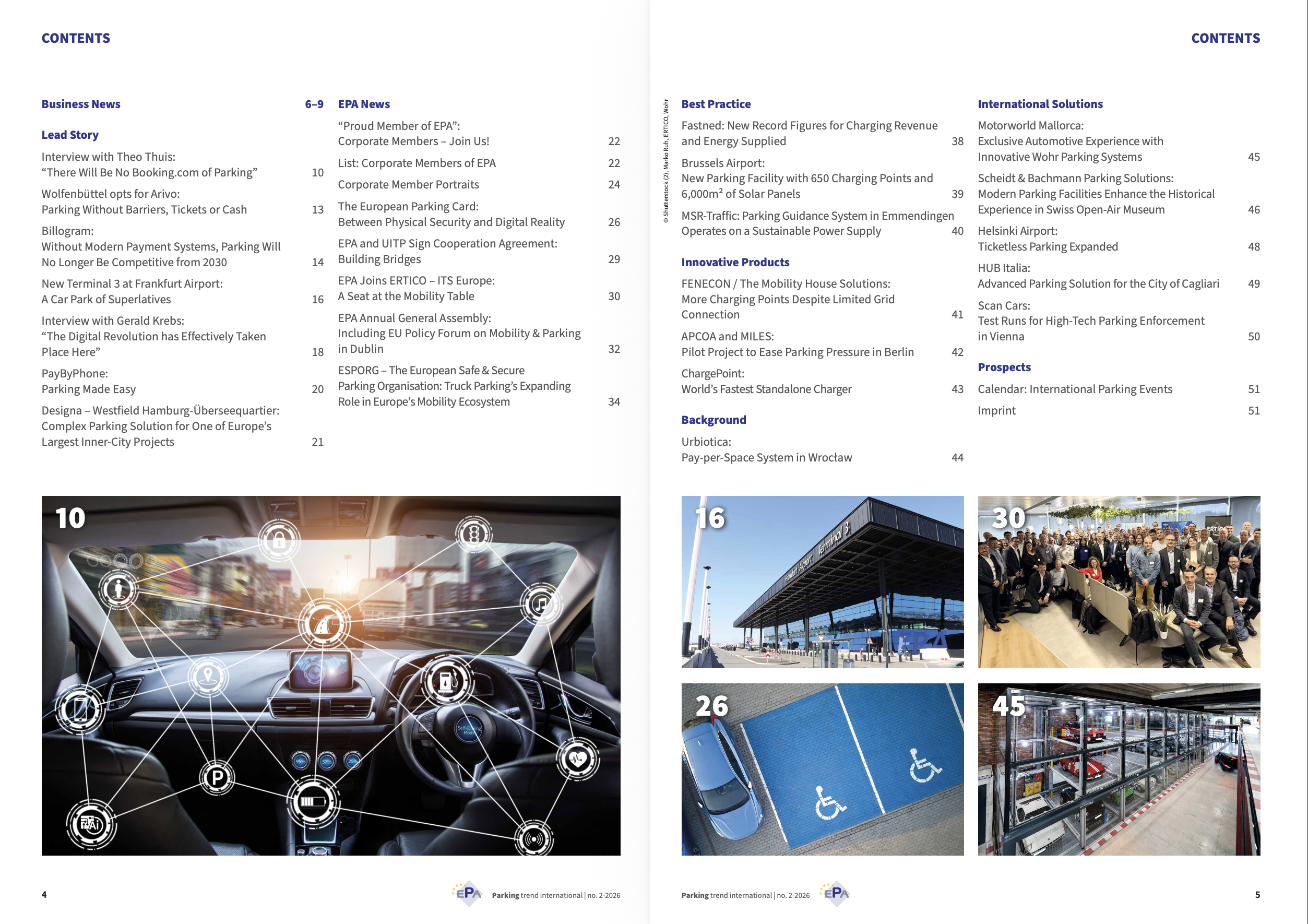
Contents:
Dear Reader,
It is a privilege to contribute this editorial as a newly appointed member of the Board of the European Parking Association. At a time when our industry is evolving at an unprecedented pace, I firmly believe that collaboration within the EPA network is more important than ever.
Parking today is no longer a standalone service. It is becoming a critical foundation of a broader, connected mobility ecosystem—one that brings together private operators, municipalities, governments, and mobility providers to jointly support accessibility, sustainability, and the future liveability of our cities.
This spirit of collaboration was clearly evident at the 2nd EPA Parking Day during Intertraffic Amsterdam earlier this year. Despite a busy calendar of competing industry events, attending in person was a deliberate choice for me. EPA’s collaboration with Intertraffic provides a unique platform where operators, cities, policymakers, and technology providers come together to exchange ideas and align on the future of mobility, including parking management. The discussions reinforced a critical message that we must move beyond siloed approaches and
embrace fully connected, data-driven ecosystems.
From my perspective, technology is the key enabler of this shift. Digitalisation, data, and intelligent platforms are transforming how parking assets are managed and how users experience mobility. But technology alone is not the end goal; it is a means to unlock greater value.
One of the most exciting developments in our sector is the emergence of urban mobility hubs. Across Europe, parking infrastructure is being reimagined to integrate electric charging, micro-mobility, logistics, and digital services into a single, multifunctional environment. This evolution reflects a broader shift from managing parking spaces to optimising urban space as a whole.
As we look ahead, the role of parking infrastructure will extend even further. Cities will increasingly operate across multiple layers—above, at, and below ground—where mobility, logistics, and urban life are seamlessly connected. Parking facilities will become dynamic platforms supporting everything from last-mile delivery to community services and new forms of urban experience.
This is not a distant vision. It is already happening, and it underscores why engagement within organisations like EPA is so important. Through its working groups, initiatives, and events, EPA provides the platform for our industry to shape these changes collectively, ensuring that innovation is aligned with the needs of cities and citizens.
Looking forward, I am particularly excited about the EPA Annual General Assembly in Dublin this September. It will be an important opportunity to continue these discussions in person, strengthen partnerships, and further define the role of our industry in shaping future mobility.
I would strongly encourage all EPA members to participate, actively engage, and contribute their perspectives. The challenges we face are complex, but the opportunities are even greater. By working together, we can ensure that parking remains not just part of the mobility system but a central driver of smarter, more sustainable, and more liveable cities.